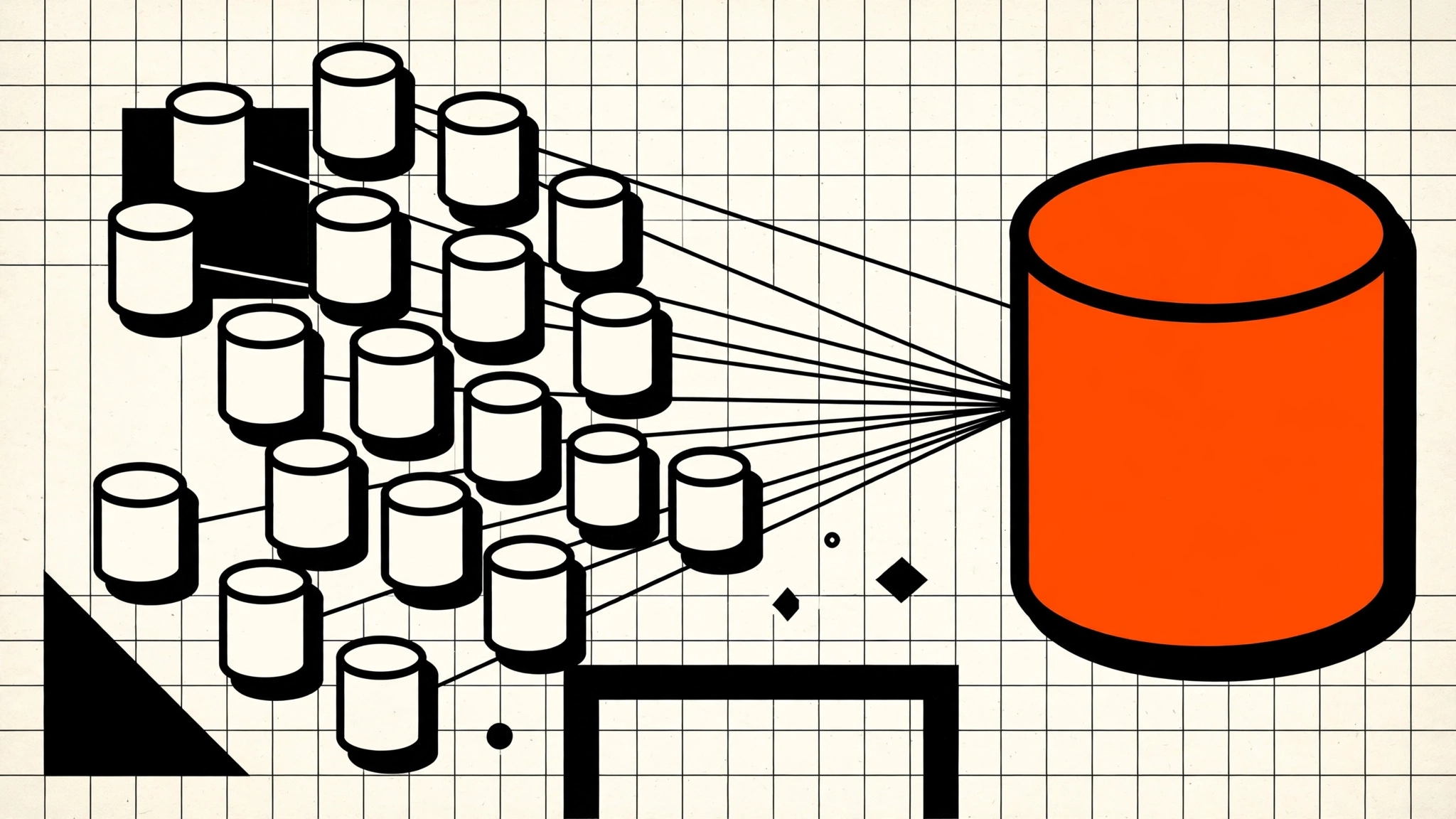
On October 2, 2026, Supabase announced it is acquiring Turso — the company that rewrote SQLite in Rust — to build infrastructure for what Supabase calls “the flood of small databases that AI agents now create.” Supabase says it already launches more than one million databases a week, and that agents are spinning up “millions of databases.” The deal is a bet that the agent era doesn’t just need more database capacity; it needs a different shape of database. Here’s what the deal covers, the economics that make one-database-per-agent work, the honest caveats, and what it means for anyone running agents in n8n.
SQLite is the most widely deployed database in the world — it lives as a single file inside your application instead of as a separate server process. Turso Database is a from-scratch rewrite of SQLite in Rust by the Turso team, designed so that millions of tiny databases can run on shared infrastructure. Supabase is the hosted Postgres company behind the database that most n8n users already know as the backing store for production workflows.
What actually happened
The facts, from the announcements both companies published on October 2 (neither disclosed a price or any financial terms):
- Supabase is acquiring Turso. Both companies announced the deal on October 2, 2026, without disclosing terms.
- The scale: Supabase says it launches “over one million databases per week,” and that agents are spinning up “millions of databases.” The million-a-week figure is not broken down into how many are created by agents, actively used, or paid for — treat it as directional, not audited.
- The people: Turso founder Glauber Costa becomes Supabase’s Head of Agentic Services; cofounder Pekka Enberg and the Turso team join too.
- The thesis, in Turso’s bluntest form: “One agent, one task, one user. Each agent deserves its own isolated database and the economics have to work at millions of databases.”
Supabase’s CEO Paul Copplestone framed it the same way: “AI is enabling builders to create an immense amount of software. Today, agents are spinning up millions of databases to power the prototypes, explorations, dashboards, and apps they’re building.” His punchline: “Agents have become the primary users of technology.”
Why an agent needs its own database
Historically, an application had one big central database. Coding agents broke that arithmetic: when an agent builds a prototype, a dashboard, or a quick internal tool, it needs somewhere to keep the data — and an agent can start hundreds of such projects in the time a person starts one.
The deeper point is isolation. An agent that shares one database with everything else needs permission logic, schema migrations, and cleanup logic it can’t be trusted to write reliably. A database that exists for exactly one agent, one task, or one user doesn’t need any of that — when the task is done, you delete the database. That is the economic argument: millions of tiny, isolated, disposable databases are cheaper to operate correctly than one giant shared database is to keep agents from corrupting.
Turso’s customers already use the model two ways. In a case study from August, Turso says CTO.new gives each project’s team of agents one shared database that acts as a task board — tens of thousands of databases in total. In a 2024 post, Turso described another customer creating hundreds or thousands of throwaway databases for a single agent’s tasks, using branching (instant, zero-copy database copies) to roll back mistakes. Both sets of numbers are vendor-reported.
What Turso actually built
The trick is that most of those millions of databases are idle most of the time. Turso’s architecture keeps each database’s recent changes in Amazon’s fast S3 Express storage, writes periodic full snapshots to ordinary S3, and uses local disk as a cache — so a single server can “manage millions of databases, loading them when needed and suspending them when they’re not,” as Supabase puts it.
The one analogy worth keeping: a hotel that has a room for every guest who ever booked, but only turns on the lights and heat in rooms that are actually occupied tonight. Idle databases cost nearly nothing; waking one up is cheap. That is how the cost per database can drop low enough to give each agent its own.
What changes for users
Supabase says “nothing changes” — at least in the short term:
- Supabase keeps building around Postgres; Turso keeps working on SQLite. The plan is a path from a small SQLite database into full Postgres when an application grows.
- Four promises from Turso: existing databases, APIs, and workflows continue; Turso Database stays open source and actively developed; there will be a route into Supabase’s Postgres; and “deeper integration” is coming in the coming months.
- Open source stays: Turso Database currently carries an MIT license, and the acquisition post names it specifically. (Note: Turso also maintains libSQL, an older SQLite fork — the open-source promise names Turso Database.) Promises about open source and product continuity are commitments to watch, not outcomes yet.
The real signal to track is the “path from a small SQLite database into full Postgres.” If Supabase ships a genuine SQLite→Postgres upgrade path — prototype on a cheap isolated database, graduate to Postgres when the app has users — that solves a real workflow problem every builder has hit: the prototype that outgrew its toy database and needed a painful migration.
What this means for n8n builders
You don’t need to wait for the integration to use the idea. The pattern the acquisition validates is directly implementable in n8n today:
- Give each agent its own state store, not a shared table. If your n8n AI Agent keeps memory or scratch state in a shared Postgres schema, one hallucinated
DELETEcan corrupt everything. A per-agent (or per-task) database makes the blast radius one task. - Use branching semantics where you have them. Turso’s branching — zero-copy copies of a database — is the database version of “checkpoint before the agent does something destructive.” If your flow has a destructive step, snapshot first.
- The prototype path already exists. Start a project’s data on SQLite (the n8n Postgres node and the Supabase node cover the managed end; a local SQLite file covers the cheap end), and move to managed Postgres when the workflow proves itself. The acquisition is Supabase betting this exact ladder becomes the default.
Hard limits and the caveat column
Honest uncertainties, stated plainly:
- The numbers are vendor-reported. Neither company disclosed financial terms, and Supabase’s million-databases-a-week figure is not broken down into agent-created vs. human-created, active vs. idle, or paid vs. free. Size the claim accordingly.
- Acquisition risk is real. Developer reaction on Hacker News was mixed: some said the deal made them more comfortable choosing Turso; others worried that acquisitions often end with products being closed or deprioritized. The open-source commitment is a company statement, not a permanent license covenant.
- Technical warts surfaced immediately. Commenters raised a slow data import in one public benchmark attempt; cofounder Pekka Enberg replied that the problem was in data loading rather than the benchmark itself and that the team intended to improve it. Worth watching if you’re moving real workloads.
- “Deeper integration” is undefined. Months away, no specifics. Don’t architect your next project around a feature that doesn’t exist yet.
FAQ
What did Supabase announce about Turso?
On October 2, 2026, Supabase announced it is acquiring Turso, the company behind the Rust-rewritten Turso Database (a SQLite fork designed for millions of small databases). No price was disclosed. Turso founder Glauber Costa becomes Supabase’s Head of Agentic Services.
Why would an AI agent need its own database?
Agents building prototypes, dashboards, and apps need somewhere to store data, and per-agent isolation removes the need for shared-schema permission logic agents can’t be trusted to write. When the task is done, the database is deleted. The economics only work if idle databases cost nearly nothing — which is what Turso’s architecture is designed for.
How much did Supabase pay for Turso?
Neither company disclosed a price or any financial terms in its announcement.
Will Turso stay open source after the Supabase deal?
Turso says Turso Database remains open source and actively developed, and its GitHub repository currently carries an MIT license. That is a company commitment, not a permanent license covenant — worth watching, not assuming.
How is this different from just using Supabase Postgres?
Supabase keeps building around Postgres for applications that have outgrown the prototype stage. The Turso side targets the other end: tiny, isolated, disposable databases for individual agents and tasks, with a promised path into Postgres when the app grows.
Key Takeaways
- Supabase is acquiring Turso (announced Oct 2, 2026, price undisclosed) to build infrastructure for the millions of small databases AI agents now create — over a million databases a week by Supabase’s own count.
- The thesis is one agent, one task, one user — isolated, disposable databases are cheaper to operate correctly than a shared database agents can corrupt.
- The trick is idle economics: recent changes in S3 Express, snapshots in S3, local disk as cache — a hotel that only heats occupied rooms.
- Short-term, nothing changes — Postgres stays Postgres, Turso stays open source (MIT). The thing to watch is the promised SQLite→Postgres upgrade path.
- The pattern is usable today in n8n: per-agent state stores, snapshot-before-destructive-steps, cheap-prototype-first data strategy.
Next step: audit one of your n8n agent workflows and ask where its state lives. If the answer is “a shared table my agent writes to directly,” that’s the exact setup this acquisition says the industry is moving away from. Split it into an isolated store per agent and see what breaks — or rather, what stops breaking.
Images: Pexels (Brett Sayles, Luis Gomes).