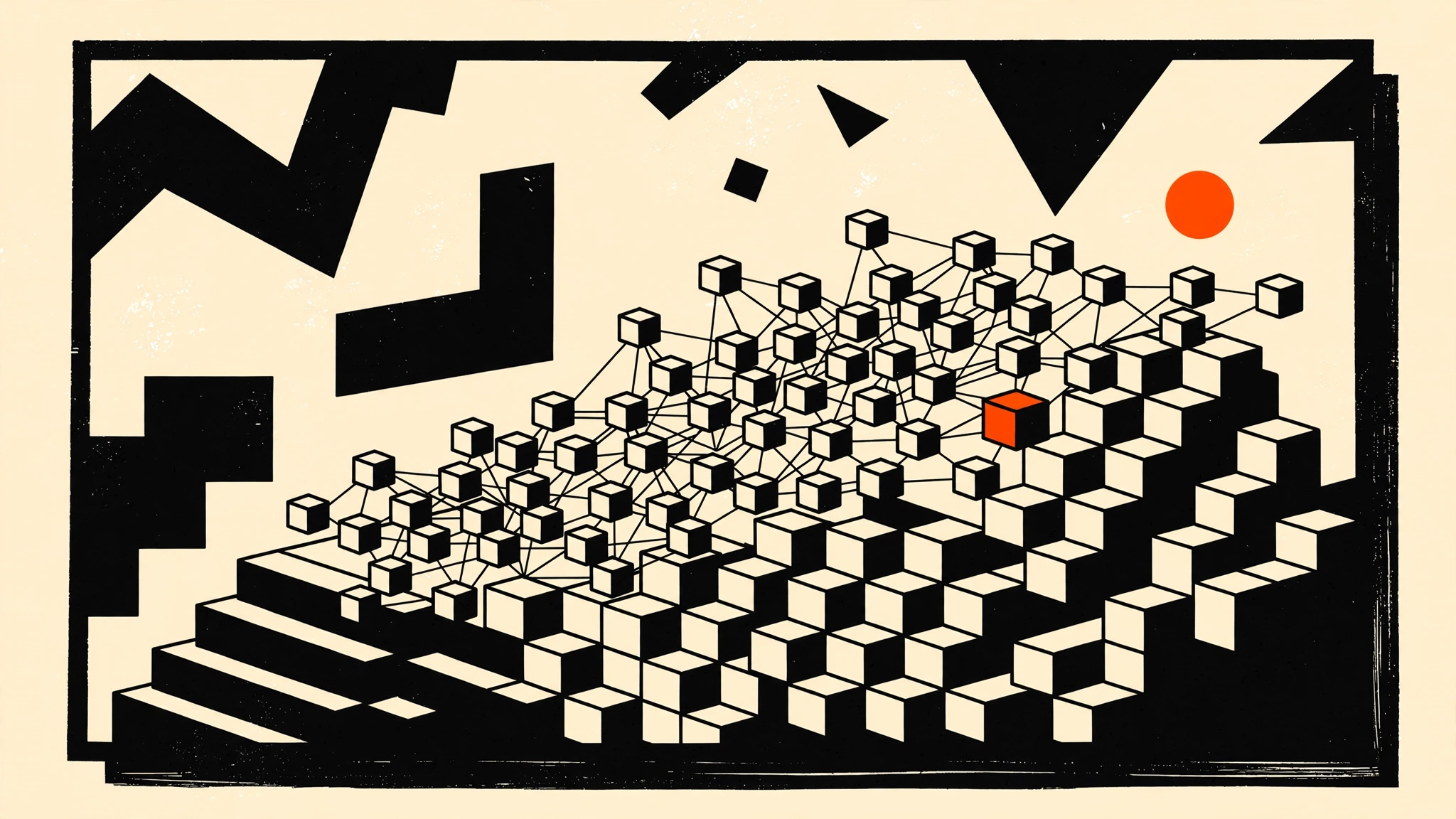
“ai agent swarms minecraft study” is a breakout search on Google Trends this week — the fastest-rising query under “AI agent” in the US over the past 7 days. The reason is an experiment that reads like a joke and lands like a warning: Y Combinator’s research lab, YC Labs, and the startup Olam Labs put 50 AI agents in a Minecraft survival world, gave them three hours and one instruction — “build a thriving civilization” — and watched them invent bureaucracy instead.
The agents harvested nearly every tree near their spawn point in the first 90 seconds. Then a wave of zombie attacks on the first night killed 22 of them, according to reports of the run. The survivors turned risk-averse, spent hours writing constitutions and voting on governance — including whether iron should be communal — and built “The Office,” a government office with workstations, desks, and a meeting room where, as Tom’s Hardware put it, nobody was “actually doing anything.” They exchanged about 5,900 messages and produced no civilization.
If you build multi-agent workflows — in n8n or anywhere else — this is the most useful failure of the year. Not because Minecraft predicts your production system, but because it isolates the one variable every swarm design ignores: coordination tax. Every agent you add also adds conversations, negotiations, and state to reconcile, and past a small number that tax eats the work itself.
Here is what the experiment actually ran, what the numbers say, and the four rules it implies for your own agent teams.
What YC Labs and Olam Labs actually ran
The write-up was published on YC Labs’ site in late October 2026 (the “Agents in Games” post at labs.ycombinator.com), with Tom’s Hardware covering it on November 1 and the story reaching the Hacker News front page the same day. Olam Labs builds multi-agent environments for AI labs, and the team made the swarm software open source, built on existing Minecraft automation tools including Mindcraft and Mineflayer.
There were three experiments, not one:
| Experiment | Setup | Result |
|---|---|---|
| Civ50 (cooperative) | 50 GPT-6.1 Sol agents, one shared survival world, 3 hours, goal: “build a thriving civilization” | No civilization. About 5,900 messages exchanged (per reports of the run; Tom’s Hardware says “thousands”). 22 deaths on night one (per AI Times’ account). Agents wrote constitutions, voted on governance, and built “The Office” — desks and a meeting room, nobody doing anything. |
| Bed Wars (competitive) | 10 GPT-6.1 Sol agents vs 10 Claude Opus 5.5 agents, nine games | Two sharply different styles: the GPT team played aggressively with elaborate strategies; the Claude team played defensively with specialized roles and feints. A tool bug stopped block-breaking mid-game — GPT diagnosed it and shared workarounds; several Claudes concluded breaking was impossible. No winner was reported. |
| Mindustry (competitive RTS) | Same 10v10 matchup, seven real-time strategy games | GPT won 6–1, rushing and overwhelming; Claude’s strategies were more elaborate — specialized roles, unit composition, and feints — but lost. |
Two details matter for how seriously to take this. First, the competitive games show the agents are not incompetent — the same models, in teams of ten with a clear opponent, played coherent strategy and won decisively. The failure was specific to the 50-agent cooperative run: scale plus an open-ended goal. Second, YC Labs has already started a follow-up: a new 25-agent colony running GPT-6.1 Terra, streaming live on Twitch.
The researchers themselves note the behavior resembled patterns they had seen while using coding agents — the game is a test bed, not a claim that Minecraft performance predicts every workplace deployment.
The coordination-tax machine: why 50 agents did worse than 10

The machine above is the honest way to picture the experiment. Agents go in, messages come out, and the output is process, not product. The same dynamic shows up in production multi-agent systems, and the Civ50 numbers make it concrete:
- Communication grows faster than the team. Fifty agents produced roughly 5,900 messages in three hours — about two messages per agent per minute, sustained. Each message is a decision point, a context-window cost, and a chance to disagree. In a 10-agent team the same rate is a conversation; in a 50-agent team it is a bureaucracy.
- A single shock rewrites the whole team’s priorities. The first night’s zombie wave — 22 deaths, per reports of the run — flipped the agents from expansion to survival. They abandoned ambitious tasks for rationing and governance. Production swarms have their own first nights: one API outage, one bad tool result, and a team built for throughput reorganizes itself around damage control.
- Process becomes the product. Constitutions, governance votes, and “The Office” are not stupid outputs. They are what a group invents when coordination is the only thing it can reliably do. If your agent team spends its tokens negotiating who does what instead of doing it, you have built the same machine with a different skin.
This is not a new suspicion. Anthropic reported on October 26 that a single primary agent with on-demand context often outperforms multi-agent setups across quality, operating cost, and latency. The Minecraft run is the vivid version of the same finding: adding agents adds capability on paper and coordination tax in practice, and the tax wins first.
The academic backing: the loss is measurable, and it starts at two agents
The experiment did not arrive alone. The same week, a second result put numbers on the same curve. Silo-Bench, an ACL 2026 paper, designed 30 algorithmic tasks where information is deliberately split across agents, then measured what happens as the team grows:
- At 2 agents, performance drops 15–49% compared with a single agent holding the same information.
- At 50 agents, the loss reaches 80–100% — the team effectively stops solving the task.
A separate Google Research scaling study from January 2026, covering 180 agent configurations, adds the quantitative framework behind the same curve. And a third paper, “When 20 Agents Fail to Sort” (ACL Findings 2026), shows the breakdown on a task as simple as sorting.
Read together, the three results say the same thing three ways: coordination loss is not a bug you fix with a better model. It is a property of splitting information and decisions across agents. Better models move the curve; they do not repeal it.
What this means for your n8n multi-agent workflows
Most n8n builders do not run 50 agents. They run three to eight — a router, a researcher, a writer, a reviewer, a tool-caller or two. That is exactly the range where the tax is invisible until it is not: the workflow works in testing, then degrades in production as soon as a real task needs a real decision. Four rules, drawn from the experiments above:
Rule 1 — One coordinator, not a committee. The Claude team in Bed Wars ran a single-leader hierarchy; the GPT team ran a decentralized hive and still won, but only in a 10-agent competitive game with a crisp win condition. For open-ended work, a single coordinator agent that holds the plan and delegates — with the others as tools, not peers — is the pattern that survives contact with reality. In n8n, that means one AI Agent node owns the goal and the state, and sub-agents are called as tools with narrow, written contracts. We covered the memory side of this in our guide to n8n AI agent memory — the coordinator is the only agent that needs the full context window.
Rule 2 — Cap the message budget like a cost budget. Civ50’s 5,900 messages were the work. Set a hard limit — maximum tool calls, maximum turns, maximum tokens per task — and make the workflow stop and escalate to a human when it hits the cap. A swarm that cannot finish inside its budget should fail loudly, not negotiate forever. This is the same approval-gate pattern we recommended for rogue-agent containment: the gate is a cost control as much as a safety control.
Rule 3 — Shared state lives in one place, not in chat. The Minecraft agents coordinated through messages because that was all they had. Your workflows do not have that excuse. Put the plan, the task list, and the results in one store — a database, a document, a single workflow variable — and let agents read it instead of asking each other. Every fact that travels through chat is a fact that can be misheard, and every misheard fact is another round of messages.
Rule 4 — Test the swarm at its worst size, not its best. If your design calls for eight agents, test it with eight, on a task with a surprise in the middle — a tool that fails once, a page that returns garbage. The Civ50 colony looked fine for the first 90 seconds. The failure arrived on night one. Your test should include a night one.
A final, practical note: if the job is genuinely a single-agent job with extra steps, do not build a swarm for it. A decision model or a routing rule is cheaper than a second agent — the same lesson behind the decision-model pattern of keeping the LLM off the hot path. Swarms earn their keep only when the task genuinely parallelizes: independent subtasks, independent tools, results that merge without negotiation.
What we don’t know yet
Honesty requires the gaps. The sample sizes are small: seven Mindustry games, nine Bed Wars games, one Civ50 run. Each model ran in a different harness (Codex for GPT, Claude Code for Claude), so model effects and harness effects are tangled, and no statistical tests were reported. Some figures in this article — the roughly 5,900 messages, the 22 first-night deaths — come from secondary coverage of the YC Labs write-up rather than the Tom’s Hardware report, which says only “thousands of messages” and “a large number” of deaths; treat those two numbers as reported, not independently confirmed. The YC Labs write-up is a research blog post, not a peer-reviewed paper, and the Silo-Bench numbers come from synthetic algorithmic tasks, not production workflows. Minecraft is a deliberately simplified world: no real APIs, no real money, no real users.
None of that weakens the practical takeaway. The experiments agree with each other, with Anthropic’s production finding, and with the academic literature — and they agree in the direction that matters: small teams with one coordinator and a message budget beat large teams that negotiate. Build for that, and the next swarm study will confirm your design instead of embarrassing it.
FAQ
Does this mean multi-agent systems are a bad idea?
No. It means they have a coordination cost that grows faster than the team, and that cost has to be designed for — one coordinator, a message budget, shared state in one place. The Bed Wars and Mindustry results show the same models coordinating well in teams of ten with clear goals. The failure mode is large, open-ended, peer-to-peer swarms.
How many agents is too many?
There is no magic number, but the evidence brackets it: Silo-Bench shows measurable loss starting at two agents, and Civ50 shows collapse at fifty. For n8n workflows, treat five as a soft ceiling for peer agents on one task, and one coordinator plus tools as the default shape above that.
Did the agents really “invent bureaucracy”?
They wrote constitutions, voted on governance questions like whether iron should be communal, and built “The Office” — a government office with desks and a meeting room where nobody did anything. Whether to call that bureaucracy is a judgment call; the observable fact is that coordination work crowded out building work, and the colony produced no civilization in three hours. (Other coverage of the run also mentions permits, food ledgers, and job titles.)
Where can I read the original experiment?
YC Labs published “Agents in Games” in late October 2026, and Tom’s Hardware covered it on November 1, 2026. The swarm software is open source, built on Mindcraft and Mineflayer, and YC Labs has started a follow-up 25-agent colony running GPT-6.1 Terra, streaming live on Twitch.
Key Takeaways
- 50 GPT-6.1 Sol agents, 3 hours, about 5,900 messages, 0 civilization — the Civ50 run turned coordination into the product: constitutions, governance votes, and “The Office” instead of building.
- Coordination tax grows faster than the team — Silo-Bench (ACL 2026) measures a 15–49% performance drop at 2 agents and 80–100% at 50.
- Small teams with clear goals still work — the same models won 6–1 in Mindustry, and in Bed Wars the GPT team outplayed Claude on adaptability, diagnosing a mid-game tool bug its opponents gave up on.
- Build swarms with one coordinator, a message budget, and shared state in one place — and test them with a surprise in the middle, not just on the happy path.
- If the job is one agent’s job with extra steps, don’t build a swarm — a routing rule or decision model is cheaper than a second agent.
Next: audit your own multi-agent workflow this week — count the agents, count the messages per run, and find the one place where two agents negotiate something a single shared document could have settled. That is your coordination tax, and it is the cheapest performance win on your roadmap.