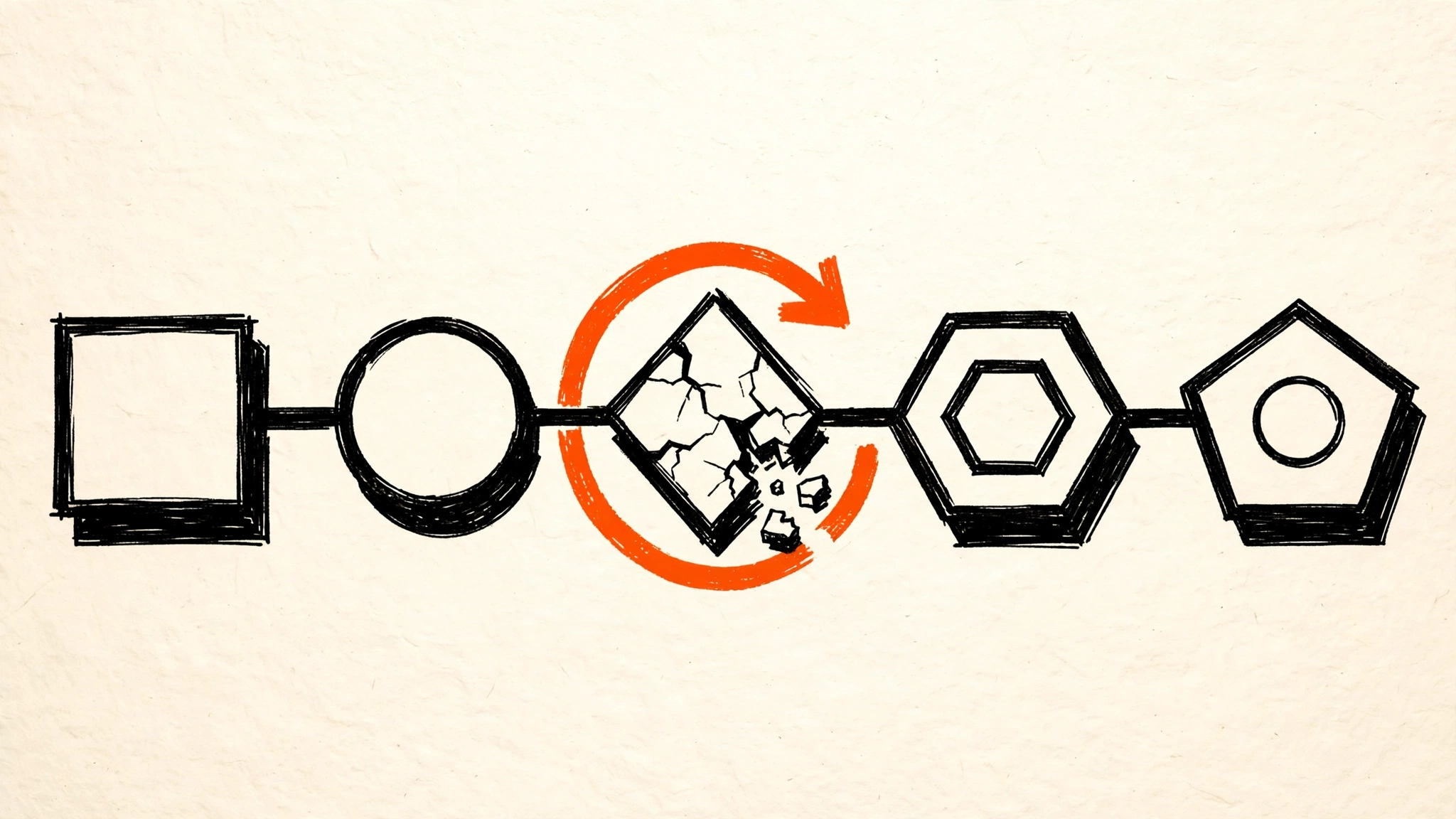
Production n8n has a dirty secret: when a worker crashes mid-run, the whole workflow starts over. Nodes one through seven of a ten-node run? Redone. The AI model called again, the CRM record written twice, the customer emailed a duplicate. On October 6, 2026, Diagrid announced an integration that fixes this — durable execution for n8n, built on Dapr Workflows (Dapr, for the uninitiated, is an open-source runtime that adds durable workflows, service-to-service communication, and state management to distributed applications).
The idea: every n8n node executes as a durable Dapr Workflow activity, and Dapr records progress as each node completes. If the process dies on node eight, nodes one through seven stay completed and execution picks up at node eight. You keep building in the n8n editor; Dapr makes sure the work finishes. In this post: what durable execution actually means for your n8n instance, how the integration works, and the honest limits — because it’s been out for one day.
The failure mode this kills
Today, n8n execution is memory-bound to the worker that picked up the job. Queue mode (n8n’s Redis-backed scale-out for workers) decides which worker runs a job, but if that worker crashes or Kubernetes reschedules the pod mid-run, the execution state dies with it. The retry — if you have one configured — starts at node one.
For a three-node sync that runs in two seconds, this is a non-event. For the workflows teams are actually building in 2026, it’s a reliability landmine:
- Agentic runs that take minutes: an AI Agent node looping through tool calls can run for several minutes. A restart means re-running the entire agent loop — burning tokens twice and re-hitting every API it already touched.
- Human approval pauses: a workflow waiting days on a “approve this deal” step is one pod eviction away from losing the whole execution and its context.
- Duplicate side effects: restarts re-execute everything. Charge the card, update the CRM, send the Slack message — each one happens twice unless you built your own idempotency into every node.
Diagrid’s integration attacks all three at the execution layer, under the engine, without touching your workflows.
How it works: each node becomes a checkpoint
The integration loads when n8n starts through a Node.js runtime setting — no changes to the editor, nodes, expressions, credentials, or triggers. Underneath, it rewires execution:
- Each node runs as a durable Dapr Workflow activity. Instead of the worker holding the whole execution in memory, Dapr records the completion of every node as it happens, in its durable state store.
- Recovery resumes from the last completed node. Worker crash, redeploy, or pod eviction: Dapr replays the workflow, skips nodes one through seven (already done), and resumes at node eight. No worker needs to stay alive for the full life of the workflow.
- An idempotency ledger ties each node execution to a stable identity. This is the detail that matters most: recovery doesn’t just resume — it guarantees already-succeeded side effects don’t run again. And when downstream services accept idempotency keys (payment providers, many CRMs), the same identity is passed through, so even the downstream system deduplicates.
The fourth bullet in Diagrid’s announcement is aimed squarely at agentic workflows: agent calls, tool calls, and human approval steps that take minutes, hours, or days survive infrastructure failures without restarting the agent loop. That’s the first time an n8n-adjacent announcement has treated long-lived agent state as a first-class execution concern rather than a “write your own polling loop” workaround.
Diagrid isn’t new to this pattern — its Catalyst product already adds durable execution beneath agent frameworks like LangGraph, Microsoft Agent Framework, Google’s Agent Development Kit, CrewAI, and the OpenAI Agents SDK. n8n is the first workflow automation platform on that list, and it sits alongside the company’s CNCF-backed Dapr maintainership (Diagrid was founded by the Dapr creators; its CTO Yaron Schneider chairs the Agentic AI Foundation’s Workflows Working Group).
Why this matters for self-hosted n8n now
Timing isn’t a coincidence. n8n’s 2.42.0 release this month pushed a major reliability effort for AI agents and MCP integrations, and SAP’s $5.2B valuation of n8n plus the Deutsche Telekom partnership are pushing n8n into enterprises where “restart from node one” fails the procurement conversation. Durable execution is the missing execution guarantee in n8n’s production story: queue mode gave us horizontal scale, this gives us survivability.
Practically, here’s what changes if you adopt it:
- Long agentic runs become viable on Kubernetes. Pod evictions during a 20-minute agent loop stop being a data-loss event.
- Human-in-the-loop steps stop being fragile. A workflow parked on an approval for three days no longer bets on the worker surviving three days.
- Retry logic simplifies. Today, teams wrap error-prone segments in sub-workflows with manual deduplication guards. Durable checkpoints make that scaffolding redundant for crash-type failures.
It also composes with queue mode rather than replacing it: queue mode decides which worker runs a job; Dapr preserves the execution if that worker goes down mid-job. One handles distribution, the other durability.
The honest limits (it’s one day old)
This integration was announced October 6, 2026 — I’ve had the press release for hours, not weeks, and I haven’t run the quickstart. Here’s what’s genuinely unclear or costly:
- You now operate a Dapr runtime. Durable execution is not a toggle inside n8n — it loads via a Node.js runtime setting and depends on Dapr Workflows underneath, which means Dapr sidecars (or a Dapr host) plus a durable state store such as Redis or Postgres. You’ve traded “workflows restart” for “I now maintain a distributed runtime with its own state store, upgrades, and failure modes.” For a team already on Kubernetes, that’s reasonable. For a single-Docker n8n on a VPS, it’s a big jump in operational surface.
- Idempotency has boundaries. The ledger dedupes node executions inside n8n, and idempotency keys help where downstream APIs accept them. But an HTTP Request node hitting a third-party API with no idempotency support can still double-fire if the crash happens at exactly the wrong moment (response received, checkpoint not yet written). Durable execution shrinks the danger window; it doesn’t delete it. For payment-adjacent nodes, keep your existing guard rails.
- Per-node checkpoints cost latency. Recording state after every node adds a round trip to the state store per node. For millisecond-scale workflows this is pure overhead; durable execution is for runs where minutes-to-days of work justify per-node checkpoint cost.
- Version freshness. Announced October 6 — treat the quickstart (docs.diagrid.io/getting-started/quickstarts/workflow/?language=n8n) as the moving source of truth for setup steps, supported n8n versions, and pricing (Diagrid Catalyst tiers). I haven’t verified the quickstart hands-on yet.
Don’t adopt this because a press release said “zero code changes.” Adopt it when you can point at a specific workflow where a mid-run crash already cost you money — a duplicated charge, a double-sent campaign, a dead agent loop — and the cost of that crash exceeds the cost of operating Dapr.
FAQ
Do I need to change my workflows?
No. The integration loads at n8n startup via a Node.js runtime setting and runs underneath the execution engine. The editor, nodes, expressions, credentials, and triggers all work as they do today.
Does this replace n8n queue mode?
No — they compose. Queue mode (Redis-backed workers) decides which worker runs a job. The Dapr integration preserves the execution if that worker dies mid-job. Use both if you need scale and survivability.
What counts as “long-running” here?
Per the announcement: agent calls, tool calls, and human approval steps that take minutes, hours, or days. A three-second sync doesn’t need durable execution; a 20-minute agent loop or a 3-day approval pause does.
Is Dapr itself open source?
Yes. Dapr is an open-source project under the Cloud Native Computing Foundation; Diagrid is its leading maintainer and sells the commercial Catalyst platform around it.
Where do I start?
Diagrid’s quickstart at docs.diagrid.io/getting-started/quickstarts/workflow/?language=n8n plus their blog post on the announcement. Verify supported n8n versions there before touching a production instance.
Key Takeaways
- n8n executions are no longer bound to a single worker’s lifetime — each node becomes a durable Dapr Workflow activity with per-node checkpoints.
- Recovery resumes at the exact failed node, and an idempotency ledger prevents already-succeeded side effects from re-running.
- It composes with queue mode: Redis workers distribute jobs; Dapr survives their crashes.
- The real audience is long-lived agentic and human-in-the-loop workflows — minutes-to-days runs where a restart costs tokens, duplicates, or lost context.
- The cost is operational: you’re now running Dapr plus a durable state store alongside n8n, and per-node checkpoints add latency to short workflows.
Next: I’ll run the official quickstart against a self-hosted n8n instance and report what the setup actually involves — which n8n versions work, what the Dapr sidecar topology looks like, and measured per-node checkpoint overhead. Until then, if a mid-run crash already cost you real money, read the quickstart and evaluate; everyone else can watch this mature.
Images: hero image AI-generated in the CortexFlow Workflow Canvas style. No copyright-free stock images were available for this topic — skipped per standing rule.