The NSA’s classified internal network went down on Tuesday, November 17 — and the reported cause was not a hack, but the patch for a bug an AI found. That inverts the story every security team tells itself: the fix is supposed to be the safe part. By the end you will know what happened at Fort Meade, why the patch cycle itself has become an outage vector, and how to build a five-part patch-resilience pattern into your n8n workflows.
“nsa” passed 200,000 searches on Google Trends’ US Trending Now list in the past 24 hours, with “apple outage” at 200,000+ on the same list (both fetched November 18, 03:20 UTC). The NSA outage is the fifth major outage in six days — and the one that changes the lesson.
What happened on November 17: NSA Net went dark
NSA Net is the NSA’s classified internal communications network, run from Fort Meade, Maryland. On Tuesday, November 17, 2026, it went down — CNN reported it first, citing five people familiar with the matter, and the NSA confirmed a “temporary degradation” during scheduled routine maintenance, with “mission-critical capabilities” fully operational. The disruption forced “Code Gray” protocols and staggered staff arrival times. There is no evidence of a cyberattack.
The irony is hard to miss: the NSA writes the patching guidance everyone else follows, and on October 21 its own advisory told organizations to patch PHP2Shell at once — or take the system offline if an immediate update was not feasible. Less than a month later, its classified network went down during maintenance, reportedly because of the patches.
The cause, as reported: the patch did it
Director of National Intelligence Jay Clayton told Fox Business the disruption stems from patches for a PHP vulnerability discovered using AI last month, with some systems failing to come back after upgrades and handoffs. That is an official’s statement, not a verified root cause — no root-cause report has been published, and the NSA’s own statement says only “temporary degradation” during maintenance.
The Washington Sun (November 18, 00:45 UTC, citing three sources) reported that bank CEOs and the NSA told members of Congress this week’s outages were caused by attempts to fix vulnerabilities identified by AI models — “the fixes, however, temporarily overwhelmed the systems.” Attribute that to the sources; it is not established fact. But two independent lines of reporting converge on the same mechanism: AI found the flaws, the fixes went out under emergency pressure, and the fixes broke things.
President Trump and Secretary of State Marco Rubio say there is no evidence linking the outages to cyberattacks; Rubio called them “completely unrelated.” The threat is not an adversary. It is the patch.
The patch cycle, explained: AI finds the flaw, the fix breaks the system
PHP2Shell, already covered twice on this blog — yesterday’s GTIG report on the AI-discovered CVEs and the full PHP2Shell patch guide — is two flaws in the PHP interpreter itself: CVE-2026-109618, RCE through out-of-memory corruption, and CVE-2026-109619, a use-after-free where one request’s leftover state can be consumed by the next request on the same worker. Each is rated CVSS 9.2, each allows unauthenticated remote code execution, and each is worst on Apache with mod_php, where the attack can succeed before any application code runs. The bug had sat in PHP’s code for roughly 14 years, since PHP 5.4 in 2012.
What makes it a story about AI is how it was found — twice, independently, by models. Calif researcher Ryan Austin found the first flaw on August 1, 2026, using OpenAI’s GPT-5.6 Sol (Patch the Planet program), reporting it to PHP on August 11; Wiz found both independently using Wiz Atlas plus Gemini 4 Argon and GPT-5.6 Sol, reporting them August 24. Patches shipped October 21, 2026 — PHP 8.5.12, 8.4.27, 8.3.36, 8.2.35 — and CISA added both CVEs to its Known Exploited Vulnerabilities catalog on October 26.
The patch window was compressed from the start: Cloudflare enabled WAF rules for all customers roughly nine hours before disclosure, its CEO reporting tens of thousands of exploit attempts in 45 minutes and millions by evening; Amazon’s MadPot honeypots logged an attempt on October 17, four days before disclosure; and six European nations took government sites down to patch. When the fix becomes a race against live exploitation, organizations patch fast, patch wide, and patch under pressure — the context in which the NSA’s systems, by the DNI’s account, failed to come back.
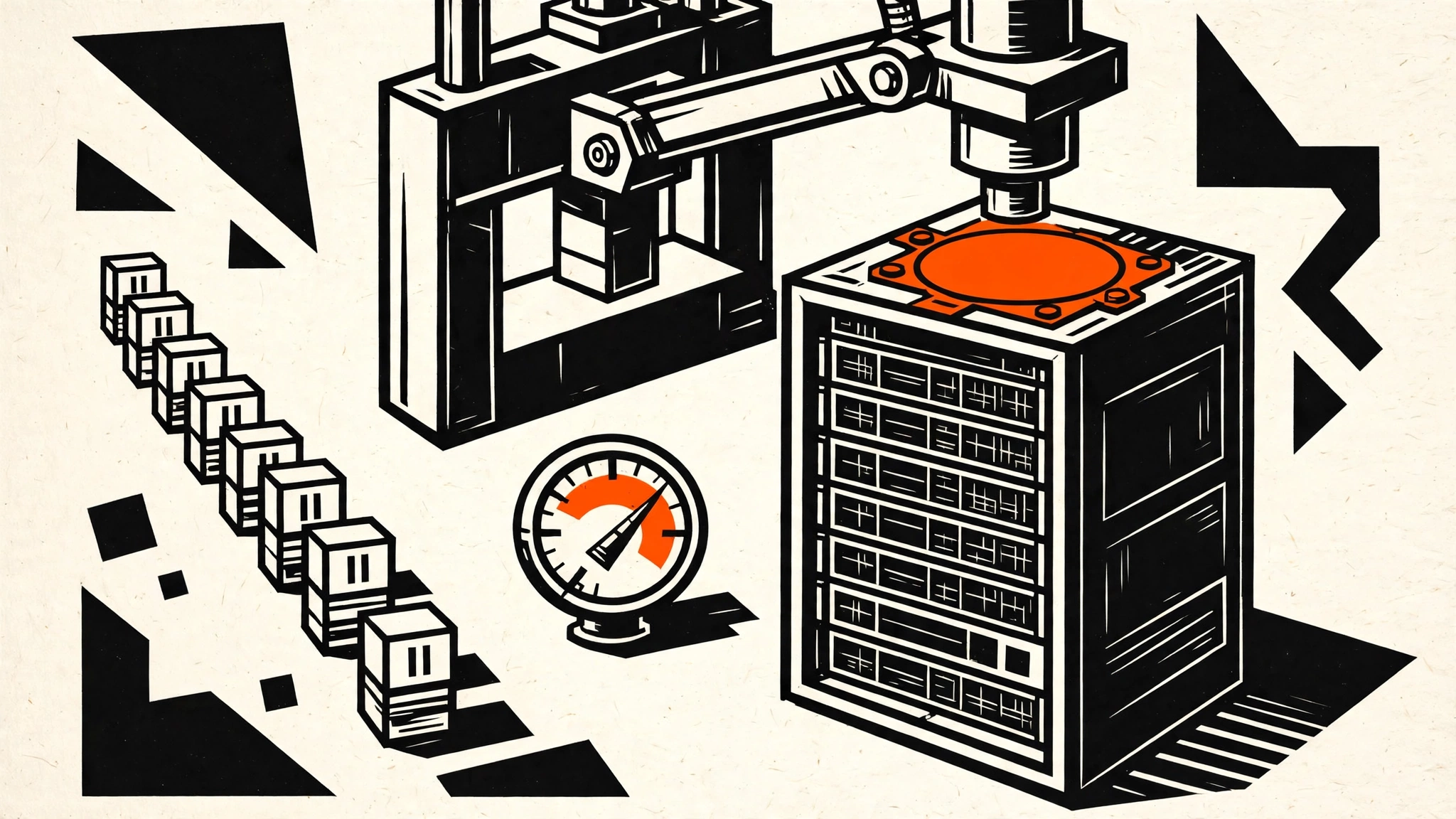
 Fig 1 — The patch-yourself-broken loop: an AI model finds a 14-year-old flaw (CVE-2026-109618 / CVE-2026-109619, CVSS 9.2), the emergency patch ships Oct 21, and on Nov 17 the patch takes down NSA Net. Notice the health dial in the orange zone and the rollback lever — the only part of the machine that can undo the damage.
Reuters put it plainly on November 17: AI is accelerating the discovery of legacy software flaws, forcing a race to patch before adversaries exploit them. AI did not cause the outage; it compressed the timeline until the patching itself became the thing that breaks.
Five outages in six days
| Date | Outage | Reported cause |
|---|---|---|
| Nov 12 | Microsoft 365 | Exchange Online incident EX1550543; ~138,000 Outlook reports at peak |
| Nov 13 | FAA nationwide ground stop | Telecom outage; ground stop 3:54–8:15 p.m. ET |
| Nov 16 | Chase bank outage | Software bug in on-premise hardware; ~4,800 Downdetector reports at peak ~2 p.m. ET; ripples to BofA, Wells Fargo, U.S. Bank, Capital One, Zelle |
| Nov 17 | Apple services | Internal update, not a cyberattack (Apple to Bloomberg); App Store, iCloud sign-in, Apple Pay, Apple Music; Apple Pay reports peaked ~12:15 p.m. ET |
| Nov 17 | NSA Net | “Temporary degradation” during scheduled maintenance; reported cause is PHP patches, per the DNI |
No common technical cause has been shown. What they share is timing: a week in which the infrastructure underneath everyday services kept breaking, in public, in sequence. The Downdetector numbers are user reports, not vendor counts.
The speculation to ignore
DHS Secretary Markwayne Mullin suggested on Fox News on Monday night that fast-moving “super intelligence” AI may be overwhelming legacy computer infrastructure and triggering a domino effect. That is unverified speculation — his own words, with no evidence offered — not a finding. On Tuesday he told CNBC, “I can tell you with 98% certainty we’re not seeing the cyberattack,” adding that “they’re pushing new technology on top of really old computer systems, and it just seems to overwhelm the system.” The second statement describes the patch-cycle problem reasonably; the first does not. The distinction decides what you do next: a superintelligence leaves nothing actionable, while a patch cycle that breaks systems points straight at patch resilience.
The patch-resilience pattern: five parts for n8n builders
Your n8n agents depend on services patched on someone else’s emergency schedule — Microsoft 365, Claude, payment rails, your own self-hosted stack. The Claude outage on November 13 showed what happens when a model dependency disappears mid-workflow; the NSA outage shows the same failure one level deeper, when the patch takes the dependency down. Here is a five-part pattern, built once and reused.
1. Canary first. Roll a patch to one staging workflow and let the agent run against it before any fleet-wide rollout — never patch production and the agent’s dependencies in the same window. The NSA’s own October 21 advisory told organizations to take a system offline if an immediate update was not feasible: a blind patch can be worse than a delayed one. A canary makes that advice mechanical: one workflow, real traffic, a fixed window, a human decision before the fleet follows.
2. Probe before acting. Put a health-check step at the start of any workflow that touches a just-patched dependency — an HTTP Request node hitting the service’s status endpoint — and if the probe fails, stop before the agent does anything irreversible. An agent that cannot tell a degraded dependency from a healthy one will happily send the payment or update the CRM against a service about to drop the write.
3. Rollback trigger. If the health probe fails N times in a row, automatically revert to the previous known-good version, disable the affected node, and page a human — and the rollback decision must not itself depend on the broken system. The NSA case is exactly that: the forward path was broken, and the only way back was the reverse path. Pick N in advance (three consecutive failures is a sane default) and write the trigger into the workflow, not a runbook nobody opens at 2 a.m.
4. Queue and idempotent retry. While the dependency is degraded, park jobs in a queue and replay them idempotently — with dedupe keys — instead of letting the agent retry blindly and double-charge or double-send. A retry loop without a dedupe key just repeats the side effect. The queue is what turns an outage into a delay.
5. Alert off the patched system. Alerts must travel on a channel that does not run on the infrastructure being patched, or you are blind exactly when you most need eyes. If your alerting runs on the same host or SaaS account as the service being patched, the patch takes your visibility with it. A separate channel is cheap insurance against what this week demonstrated: the system that broke was also the system that would have told you it broke.
One standing rule sits above all five parts, and the n8n 2.43.0 agent guardrails release makes it easier to enforce: no agent auto-applies patches to production without a human approval gate. An agent that can patch its own host can reproduce the NSA’s week on your infrastructure, with nobody watching. The approval gate is the one control that keeps an automated patch cycle from becoming an automated outage cycle.
What we still don’t know
Honesty about the gaps: the PHP-patch cause rests on DNI Clayton’s statement and the Washington Sun’s three anonymous sources — no technical root-cause report has been published, and the NSA’s own statement says only “temporary degradation” during maintenance. Mullin’s theory is unverified speculation. The Downdetector numbers are user reports, not vendor counts, and the five outages may share nothing but a bad week.
What is established is narrower: AI models found a 14-year-old flaw in PHP twice over, the patch shipped October 21, exploitation attempts began within minutes, and on November 17 the agency that told everyone to patch saw its own network degraded during maintenance. Do not claim the NSA was hacked, or that AI caused the outage. The claim is that AI-found flaws forced a patch race, and the patching itself broke things.
FAQ
Was the NSA hacked?
None. CNN, the NSA, and officials all say there is no evidence of a cyberattack, and the President and Secretary of State have said the same. The reported cause is the agency’s own patching, not an adversary.
What is PHP2Shell, in one paragraph?
Two flaws in the PHP interpreter itself — CVE-2026-109618 (RCE through out-of-memory corruption) and CVE-2026-109619 (a use-after-free where one request’s leftover state can be consumed by the next request) — each rated CVSS 9.2, each allowing unauthenticated RCE. The bug had been in PHP since version 5.4 (2012); patches shipped October 21, 2026 as PHP 8.5.12, 8.4.27, 8.3.36, and 8.2.35.
Why would a patch take a network down?
Patching is not just swapping a file: services must restart, workers must recycle, and handoffs between systems must complete in the right order. The DNI’s account is that some NSA systems failed to come back as expected after upgrades and handoffs. That is a normal patch failure mode — it just rarely happens to the NSA in public.
I run n8n workflows, not a classified network. Why should I care?
Your agents have the same dependency shape at a smaller scale: they call services emergency-patched on someone else’s schedule, and a patch that takes a dependency down looks to your agent exactly like the dependency disappearing.
Key Takeaways
- NSA Net went down on Nov 17 during maintenance, and the reported cause is the patch, not a hack — per DNI Clayton and three Washington Sun sources.
- PHP2Shell is the flaw behind the patch — two AI-found, unauthenticated RCEs (CVE-2026-109618 / CVE-2026-109619, CVSS 9.2) in PHP since 2012, patched Oct 21 under live exploitation.
- AI compressed the discovery-to-patch timeline until the patching itself became the outage vector.
- Patch resilience is a builder skill now — canary, probe, rollback trigger, queued idempotent retries, off-system alerts.
- No agent auto-applies patches to production without a human approval gate — the control that keeps an automated patch cycle from becoming an automated outage cycle.
Next step: pick your most business-critical n8n workflow, add the health-probe node from part 2 today, and set the rollback trigger from part 3 before the next emergency patch lands.